Tuesday, September 29, 2015

Why Steinbeck Still Matters


The first book I read by John Steinbeck was Once There Was a War, which featured the author’s war time writing as he followed American troops during World War II. For me it remains one of the best pieces of war time writing that is free of any political bias but portrays the realities and human stories (some of them with humor) that surrounded American soldiers. 
I decided to read Grapes of Wrath and I have been blown away by the power of the writing. He captures the spirit of desolation, isolation, frustration and avarice that really brings home the experience of so many Americans in the 1930 moving from Oklahoma and Kansas to California.
A lot of what Steinbeck wrote about remains very relevant today. Take for example this text from The Grapes of Wrath, “It ain’t that big. The whole United States ain’t that big. It ain’t that big. It ain’t big enough. There ain’t room enough for you an’ me, for your kind an’ my kind, for rich and poor together all in one country, for thieves and honest men. For hunger and fat Whyn’t you go back where you come from?” In the text the character is speaking to Americans from Oklahoma and Kansas migrating to California. We see that issues of class pervade the sentiment. There is no indication of race in the disquisition, but that does not mean it wasn’t there. Fast forward to 2015 and this same character would direct the same message to a different audience: to immigrants and to the lower class. Steinbeck mocks the lack of education of those who abused the migrants in the 1930 by imbuing their language with vocabulary that speaks to their incivility. Little did he know that he was ridiculing those who many years later would become more prominent in American public life: the Tea Party. Economies change, technologies change, even societal experiences change, Steinbeck seems to say, but stupidity never changes.  What would Steinbeck say if he were alive today? What would he make of Wall Street financiers and the Occupy movement? Or the Black Lives Matter movement?
There are moments in The Grapes of Wrath where Steinbeck is optimistic about mankind’s future. He writes, “For man, unlike any other thing organic or inorganic in the universe, grows beyond his work, walks up the stairs of his concepts, emerges ahead of his accomplishments.” But then, he writes a more harrowing view of humanity: “Having stepped forward, he may slip back, but only half a step, never the full step back. This you may say and know it. This you may know when the bombs plummet out of the black planes on the market place, when prisoners are stuck like pigs, when the rushed bodies drain filthily in the dust.” Ultimately, I think Steinbeck believed in humanity as long as it did not give up on concepts and belief. He writes in The Grapes of Wrath, “And fear the time when the strikes stop while the great owners live—for every little beaten strike is proof that the step is being taken. And this you can know—fear the time when Manself will not suffer and die for a concept, for this one quality is the foundation of Manself, and this one quality is man, distinctive in the universe.”
Much of what Steinbeck wrote about is relevant today. The audience may have changed, but the message is still the same. If only we would be smart enough to listen.

Wednesday, August 5, 2015

Are you Twitterpated?


twitterpated
Here is a word you don't see every day. I just learned it. Now how can I use it?  Thanks, Dictionary.com for this lovely new word!

Friday, July 24, 2015

A Photo of Contrasts


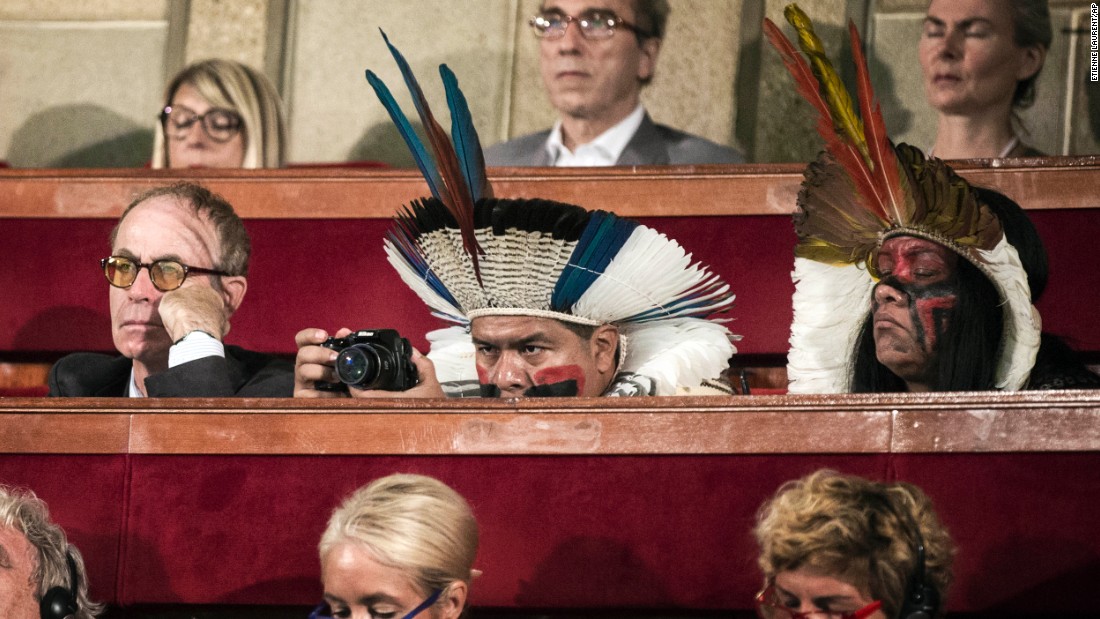
Delegates, some in traditional dress, attend the opening of a climate summit in Paris on Tuesday, July 21. French President Francois Hollande called for an ambitious accord ahead of a United Nations conference to address the threat of global warming.


This photo caught my eye for a couple of reasons. It was taken on July 21, 2015 in France just before the opening of a climate summit in France. First, I see two people who appear to be dozing in the back and second the individuals wearing their traditional clothing. It contrasts sharply with what the other people around them are wearing.

It made me wonder: would we ever see a Native American Indian wear traditional clothing at at session of US Congress? Probably not.

Source of photo:  http://www.cnn.com/2015/07/24/world/gallery/week-in-photos-0724/index.html

Wednesday, July 22, 2015

When an Ice Berg Strikes


The recent controversy surrounding the awarding of the Arthur Ashe Courage Award to Caitlyn Jenner (formerly the Olympic great Bruce Jenner) provoked me to ask two questions: 1) “Who the hell is Peter Berg?” (Did an ancestor sink the mighty Titanic in 1912?); and 2) “Why the controversy over bestowing an award for such a meaningless event (ESPN’s the ESPYs)? Before I go let me just say that this takes nothing away from what Arthur Ashe did and represented. Even after his death his legacy continues to inspire hope, dignity, resiliency and humanity.  The problem I have is that we have become so sports-centric that we have elevated sports/entertainment to the level of cultural/historical/academic/political importance. This should not be. I enjoy sports, but I have come to understand that they are only a fraction of what life is truly about, or the strenuous decisions people have to make.

As I read the article on the controversy, I saw that Bob Costas, the NBC broadcaster, chimed in with his officious two-cents. He is quoted as saying, “In the broad world of sports, I’m pretty sure they could’ve found someone – and this is not anything against Caitlyn Jenner – who was much closer actively involved in sports, who would’ve been deserving of what that award represents.” English teachers should use this sentence in class. Costas should have used “more” instead of “closer” or “much more closely involved.” It appears that Costas has a bias against transgendered people and this comes out in his judgment of Jenner. As an Olympian Jenner embodies and represents the athletic ideal and greatness. Even though she no longer competes, her struggles transcend anything that happens between two lines, a court, a soccer field, etc.  Ashe was recognized for his work outside of the tennis courts, why can’t Costas apply the same standard to Jenner? 

The real issue here is that the criteria for the award has never really been defined. Should the recipient be a current athlete or one who has retired? Should he/she be acknowledged for work outside of athletics or not? Should the award go to the individual who practices a sport that most represents people/society? Cindy Boren, the reporter who researched and put together the article for The Washington Post, wrote, “Jenner was a controversial choice for the award, with many pointing out that Noah Galloway, an athlete who lost an arm and leg in war, was more deserving, as was Lauren Hill, who achieved her dream of playing college basketball before she died of brain cancer.” Should we now require that athletes who were involved in war be given preference for the award? Or how about a dying individual? Both are extremely good choices for the award, but at some point ESPN is going to have to validate the award by imbuing its criteria with more substance than it has.

As for Mr. Berg, it is sad that he felt it necessary to engage in such a petty, disgraceful and immature act as his posting illustrates. No one disrespects Gregory Gadson, the Army veteran who lost two legs in conflict, whose image Berg used to deride Jenner. In reality, Gadson should be insulted that Berg used his image without his consent for such a pathetic example of stupidity.


It is a shame that battlefields are the metric for determining a person’s worth or value. Not all battles take place in Afghanistan, Vietnam, Iraq or Baltimore, Maryland. I remember seeing pictures of Bruce Jenner on Wheaties cereal boxes in the 1970s and I was struck that he had to struggle with identity issues for so long. Army veterans proudly display their injuries sustained in battle; others, such as Caitlyn Jenner, have wounds that run just as deep, but are not as visible. The battles that people like Caitlyn Jenner are fighting are no less important than the conflagrations that US armed forces have with ISIS and the Taliban or that Bob Costas may have with an English grammar book. If we give too much weight or credence to what Peter and Bob say, it will “Costas” in the end.


http://www.out.com/sites/out.com/files/jenner-wheaties.jpg